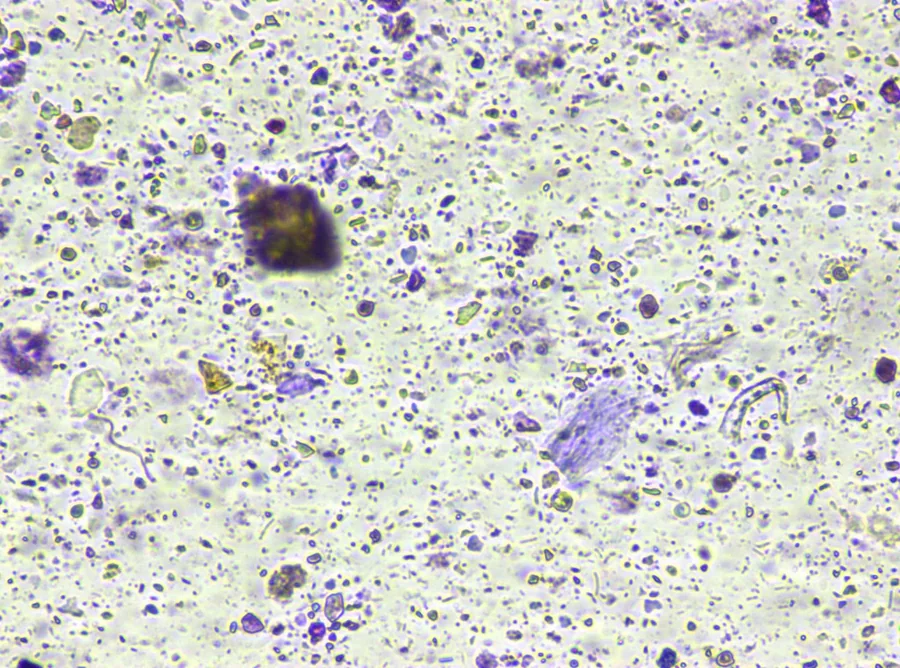
Nearly all puppies are born with parasites. This is not a sign of a careless breeder: Toxocara canis larvae remain encysted in the dam's tissues for years, reactivate during pregnancy and pass to the foetuses through the placenta, then to the newborns through the milk. A wormed, perfectly healthy bitch can still give birth to an infested litter. That is why worming starts as early as two weeks of age and is repeated at regular intervals, and why a blind protocol is not enough: the only way to know what is actually there is a laboratory faecal examination. The reports for our August 2026 litter are published below in full, positives included, with the laboratory's name and the date.
That is why worming is not the answer to a problem that has appeared: it is a procedure planned from day one and carried out regardless. What sets one breeder apart from another is not claiming to have done it, but being able to prove it.
The schedule
The European ESCCAP guidelines set out a precise scheme for puppies:
- First treatment at 2 weeks of age.
- Repeat every 2 weeks, until two weeks after weaning.
- Then monthly, until 6 months of age.
- The dam is treated alongside the puppies, because she sheds eggs into the environment and reinfests them.
The two-week interval is not arbitrary. Wormers act on adult parasites in the gut, not on larvae migrating through the tissues. Treating every two weeks means hitting each new generation before it starts laying eggs. A single treatment, done just so it can be declared, leaves the cycle intact.
Worming is not enough: you need the test
No wormer covers everything. Fenbendazole works on roundworms, hookworms, whipworms and also on Giardia, but has little effect on Dipylidium caninum, the tapeworm carried by fleas. Milbemycin oxime combined with praziquantel covers nematodes and cestodes, but has no effect at all on Giardia and coccidia, which are protozoa rather than worms.
The conclusion is simple: without a faecal test, you do not know what you are treating against. Worming blind and declaring "puppies wormed" asks the listener for an act of faith. A laboratory report, by contrast, is a document anyone can read and check.
Our litter's test results
On 17 September 2026 we had a faecal sample from the whole litter analysed at Dr. Giovanni Franzoni's veterinary practice in Sant'Agostino di Terre del Reno (Ferrara, Italy). Two separate tests, using two different methods.
Giardia antigen test, quantitative immunofluorescence: negative, with a value below 4 Tu/ml against a positivity threshold of 8. Not a borderline negative: a negative at less than half the threshold.
Faecal morphology examination:
| Test | Result |
|---|---|
| Roundworm eggs | None |
| Hookworm eggs | None |
| Tapeworm and Dipylidium eggs | None |
| Coccidia | None |
| Trichomonas | None |
| Bacterial flora (cocci/bacilli ratio) | Within range |
| Digestive function (starch, fat, muscle fibres) | Normal |
| Blood and inflammatory cells | None |
The picture is one of puppies with a healthy gut: no parasites, balanced flora, digestion working as it should. That is not luck. It is the result of a protocol applied from the second week of life and of an environment kept clean.
📄 The full reports: download the PDF of both tests — results table, microphotographs and the Giardia antigen test. The reports are in Italian.
One line in red, and why it is not a problem
Anyone opening the reports will notice an entry highlighted in red: in the morphology examination, the line "Giardia SPP" shows a value of 1. It is worth explaining, because it is a good example of how these documents are read.
The morphology examination is carried out by an automated analyser that photographs the slide and classifies what it sees by shape. It is fast and reliable on counts, but on a single isolated element it can be wrong: a yeast, a plant fragment or a cell can resemble a protozoan. Its reference range for Giardia is zero, so any element classified as such triggers the flag.
The second test answers the same question by a different method. The antigen test does not look at shapes: it looks for the parasite's specific protein. And it came back negative, below half the threshold. When a morphological method and an antigen method disagree over a single element, the latter prevails, because it is specific to that organism.
On top of that, the puppies show no matching signs: formed stools, no diarrhoea, steady growth. The same report documents normal digestive function and balanced bacterial flora, neither of which an active giardiasis would leave untouched. Finally, the fenbendazole treatment under way is itself active against Giardia, so the question is closed from both ends: the specific test says negative, and the treatment would cover the hypothesis anyway.
We publish the reports in full, red line included. A document is either attached as it is, or not attached at all.
The treatment under way
A negative test does not close the programme: it confirms it. The litter is completing a course of fenbendazole over 6 consecutive days, followed by a treatment with milbemycin oxime and praziquantel a few days before the first vaccination.
The two products do not overlap, they complement each other. Fenbendazole covers roundworms, hookworms, whipworms and acts on Giardia, which is why it is given over consecutive days rather than as a single dose. The second adds praziquantel, the only molecule genuinely effective against tapeworms, Dipylidium included.
The timing of the last treatment also has a precise reason: giving it just before vaccination means arriving at the appointment with a clear gut, because a significant parasite burden can reduce the immune response to the vaccine.
💡 Note: doses are calculated on the animals' actual weight, not by eye, and every product is bought on a veterinary prescription. Products and dosages should always be agreed with your own vet.
What our puppy owners receive
None of this stays inside the kennel. As tests are carried out and treatments given, we send copies to the new owners: laboratory reports, products used, dosages and the date of every administration. Not at the end, as a single package to sign, but along the way, as things happen.
It is a matter of fairness before it is a matter of transparency. Anyone waiting for a puppy has the right to know how it is growing and what it is being given, at the time it is given. And when the puppy reaches its new family, the health record carries the complete history, which their own vet can read and continue without having to reconstruct anything.
How it continues in the new home
The schedule does not end with the move:
- Monthly treatment until 6 months, then according to individual risk and your vet's advice.
- A faecal test once the puppy has settled in, usually 2-3 weeks after arrival.
- External parasite control: fleas carry Dipylidium, so worm control also runs through flea control.
- Watch for persistent loose stools in the first weeks: in a newly moved puppy these are more often settling-in stress or a change of diet than parasites, but they should be reported to the vet.
⚠️ One thing to always ask for, from us as from anyone else: the reports. Breeders who do things properly have no reason not to show them.