Why prevention beats treatment
Parasite control is one of the few areas of dog health where the correct approach is entirely predictable and almost entirely effective. Nearly everything that matters can be prevented with a calendar and a small monthly cost, and nearly every serious case seen by veterinarians involves a dog whose prevention lapsed.
For the Staffordshire Bull Terrier there is one breed-specific consideration worth stating early: the short, dense coat makes fleas and ticks easier to spot than in a long-coated breed, which is an advantage. But the same coat, combined with skin that is prone to allergic reaction, means that flea allergy dermatitis is disproportionately common and disproportionately miserable. A single flea bite can trigger weeks of scratching in a sensitised dog.
Fleas
The flea you see on the dog represents about 5 per cent of the infestation. The remainder — eggs, larvae and pupae — is in the carpet, the bedding, the sofa and the cracks in the floor. This is the single most useful fact about fleas, because it explains why treating the dog alone repeatedly fails, and why an infestation appears to return a fortnight after it was solved.
Signs to look for: scratching concentrated at the base of the tail and along the back, small scabs, and flea dirt, which looks like specks of black grit and turns rust-red on damp white paper. That test is definitive and takes 10 seconds.
Treatment means treating every animal in the household simultaneously, on the same day, plus the environment: hot washing of all bedding, thorough vacuuming including under furniture with immediate disposal of the bag, and in heavy infestations an environmental product with an insect growth regulator. Repeat after 3 weeks to catch the generation that hatches from pupae, which are resistant to everything.
Ticks
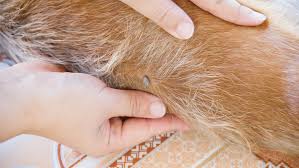
Ticks matter less for the bite than for what they transmit: babesiosis, ehrlichiosis, borreliosis and, in parts of southern Europe, hepatozoonosis. In Italy, babesiosis in particular can be rapidly life-threatening, and it is the reason we treat tick prevention as non-negotiable for dogs that walk anywhere near long grass.
Check the dog after every walk in grass or woodland during the season, which in most of Italy now runs from March to November and in mild coastal areas effectively all year. Concentrate on ears, neck, armpits, groin and between the toes.
To remove one, use a tick hook or fine tweezers as close to the skin as possible, and pull steadily with a twisting motion. Do not apply oil, alcohol or a flame: a distressed tick regurgitates, which is precisely how pathogens are transmitted. Note the date, and watch for fever, lethargy or dark urine over the following 3 weeks.
Intestinal worms
Roundworms, hookworms, whipworms and tapeworms are the common group. Puppies are effectively born with roundworm from the dam and must be wormed on a strict schedule: every 2 weeks from 2 weeks of age until 12 weeks, then monthly to 6 months. This is the breeder's responsibility for the first part and the owner's thereafter, and the dates should be written in the health record you receive.
Adults are typically treated every 3 months, adjusted upwards for dogs that hunt, scavenge or live with small children. Tapeworm is transmitted by ingesting fleas, which is one more reason the two problems are managed together rather than separately.
Signs of a burden: a dull coat, a pot-bellied appearance in puppies, weight loss despite good appetite, visible segments like grains of rice around the anus, and scooting, which is more often anal glands but is worth investigating.
Heartworm and leishmaniasis
These are the two that owners in southern Europe cannot afford to treat casually. Heartworm, transmitted by mosquitoes, is endemic in the Po Valley and much of northern Italy, including our own area. Prevention is a monthly treatment through the mosquito season, and it is essential to test before starting prophylaxis in a dog whose history is unknown, because treating an infected dog with a preventive can be dangerous.
Leishmaniasis, transmitted by sandflies, is endemic across the Mediterranean and expanding northwards. It is a serious, often lifelong disease. Prevention combines a repellent collar or spot-on with proven anti-feeding action, avoiding outdoor exposure at dusk and dawn during the season, and, where recommended by your veterinarian, vaccination. Any dog travelling to or from southern Italy should be protected before the journey rather than after.
A practical annual plan
Monthly, all year: a combined product covering fleas and ticks, chosen with your veterinarian, plus heartworm prevention through the mosquito season. Every 3 months: intestinal worming, or more often for at-risk dogs — and in puppies the schedule is checked against a faecal examination. Weekly: a hands-on check of coat and skin, which takes 2 minutes and catches most problems early. Annually: a veterinary check that includes discussion of the local parasite picture, because it changes.
One caution on products: never use a preparation formulated for cats on a dog or the reverse, and never use permethrin-based products in a household with cats. And be sceptical of natural alternatives such as garlic or essential oils. Garlic is toxic to dogs, several essential oils are also toxic, and none of them prevent babesiosis.
Frequently asked questions
My dog never leaves the garden. Does it still need prevention? Yes. Mosquitoes carrying heartworm and sandflies carrying leishmaniasis do not require the dog to travel, and flea eggs arrive on shoes and clothing. A garden-only dog needs the same protection as any other.
Can I use the same product all year? Often yes, and consistency is valuable because gaps are where problems start. What matters is that the combination covers fleas, ticks, heartworm and intestinal worms across the year, not that it is a single product.
Is a collar as effective as a spot-on? For repelling sandflies, the evidence for collars with proven anti-feeding action is strong. For fleas and ticks, both formats work when used correctly. The practical difference is that a collar must be worn continuously and correctly fitted to do anything at all.
I found a tick and pulled it out. Should I worry? Watch for 3 weeks and note the date. Fever, lethargy, pale gums or dark urine mean an immediate veterinary visit with that date in hand. Most tick bites transmit nothing, but the ones that do move quickly.