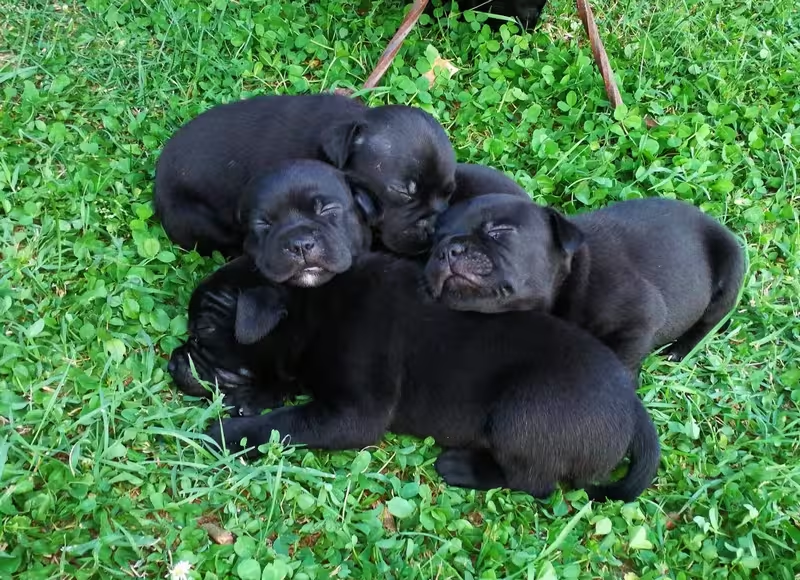
Recognising a serious Staffordshire Bull Terrier breeder does not require trusting anyone: it requires knowing where to look. Genetic test certificates are only valid if they carry the dog's microchip number, otherwise they cannot be tied to any animal. Genealogies can be checked on SBTPedigree, the breed's international archive. The number of litters a bitch has had is checked in the ENCI stud book, again starting from the microchip. Show titles appear in public catalogues, with the judge's name. Selling a puppy before 60 days of age is prohibited by Italian law, and puppies going abroad leave later because they need a rabies vaccination. Eight criteria, each with the way to check it: they apply to the Del Piccolo Diavolo kennel in Ostellato, Italy, as much as to any other.
Nearly every kennel says the same things: tested dogs, puppies raised indoors, careful selection. Those claims cost nothing until somebody checks them, and a first-time owner rarely knows where to start checking.
This guide is built the other way round. For each criterion you get how to verify it — what to ask, where to look, which document to insist on. And so you are not left with theory alone, under each criterion we put our own document: use us as the exercise, then put the same questions to anyone else.
1. Genetic tests on the breeding dogs
The Staffordshire Bull Terrier has two known inherited diseases: L2HGA, a neurological condition, and HC, hereditary cataract leading to blindness. Both are autosomal recessive: two healthy carriers can produce affected puppies.
How to verify. "They are tested" is not enough. Ask for the certificate as a PDF and check it carries three things: the laboratory's name, the dog's microchip number and the date. A certificate without a microchip cannot be tied to any particular animal. If what arrives is a blurred photo or a cropped screenshot, press for the document.
Ours. The certificates of our breeding dogs are published on the site, not sent on request: Bilquis, Nora, Minnie. For dogs we do not own we publish the certificate when the owner agrees, as with Quash, Black Jack's sire; otherwise we report its details — laboratory, reference number, date, microchip and results.
2. Clear by parentage, or simply clear?
A young puppy is often not tested individually: it is called clear by parentage. That is sound, on one condition: both parents must be clear for that mutation. If a breeder declares a puppy clear for four conditions but holds the tests of only one parent, three of those four claims do not stand.
How to verify. Put the two certificates side by side and compare condition by condition. Where a parent is missing, the guarantee is missing.
Ours. On the page for the August 2026 litter we say exactly this: the puppies are clear by parentage for L2HGA and hereditary cataract, and they are not for hyperuricosuria and MDR1, because for those two we hold the sire's certificate only.
3. The pedigree, and who is inside it
The ENCI pedigree is the only document certifying that a dog is a Staffordshire Bull Terrier with identified parents. It is not an extra and it is not charged separately.
How to verify. The pedigree itself is checked against its stud book number. But there is a further step almost nobody takes: the breed's genealogies are public on SBTPedigree, an international database (how to use it is in how to read a pedigree). Look up the grandparents and great-grandparents, see whether they exist, whether they hold titles, whether they appear in other kennels. A tree that stops after two generations tells you something.
Ours. Our dogs are registered on SBTPedigree with every dog and every litter. From there you can trace anyone, ourselves included.
4. How many litters, and how often
A brood bitch is not a production line. A kennel with puppies available all year round is producing numbers, not selection. Constant availability is the clearest signal of all.
How to verify. Look at the history of the litters, not only the current one. If the dates are public you can count them yourself; if they are not, ask how many litters have been born in the last three years and from which females. A vague answer to a numerical question is already an answer.
Ours. The diary carries the dates of the recent litters, and the earlier ones are in the breeding programme: none of them disappears. One a year, occasionally two, sometimes none at all.
5. The mother, in person
Seeing the mother with her puppies is the hardest check to fake. It tells you how she is, what temperament she has and the environment the puppies grew up in. It is also why anyone with something to hide suggests meeting halfway.
How to verify. Ask to see her in the house, not in photographs, and watch how she reacts to the breeder. If the mother "is at the vet" or "is staying with a friend", the visit loses most of its point. Refuse motorway handovers and shipping: those are the methods of trade, not of breeding.
Ours. The Del Piccolo Diavolo kennel receives visitors by appointment in Ostellato, in the province of Ferrara. You see the mothers, the puppies and the house they grow up in.
6. What happens to the mother afterwards
This is the question almost nobody asks, and it is the one that tells you most: where will my puppy's mother be in three years?
The ENCI rules set a limit on how many litters a bitch may have, and beyond a certain age a veterinary certificate is required to breed her. These are sensible limits. The problem is those who use them the other way round: not as a ceiling to respect, but as a target to reach.
There is a phrase that gets used a lot, and it sounds good: rehoming from the heart. An adult dog placed with a family, free or nearly so. Put like that it sounds generous, and sometimes it genuinely is. But two things are worth looking at.
Who gets rehomed. Almost always females, and that is no accident. A kennel keeps few males or none: outside studs are used, both to avoid closing the lines around the one dog at home and because a male worth keeping has to be genuinely outstanding. Females are the ones who produce — and therefore the only ones who, at some point, stop.
When. Almost always after the last permitted litter, or around seven or eight years of age: exactly when that female stops producing. Not at two, not at four. Right then.
How to check, without asking anyone. The number of litters a bitch has had can be looked up in the ENCI stud book: you need the microchip number. You do not have to take anyone's word for it — provided the microchip is public.
And this is where the criterion closes itself: a breeder who does not publish the microchips of their brood bitches makes that check impossible. They may have their reasons, but the result is that on the number of litters you have only their word.
Ask anyway. Where are the females who whelped in previous years, and can you see them. How many litters one of their bitches has, and what happens when she stops. Anyone with an answer ready has it because they have already asked themselves the question.
Ours. The microchips of our females are in plain sight, precisely so that the check can be made without going through us. They have two litters each on average.
 Our females, with microchips and pedigrees
Eight profiles with the microchip number: you check the litters on ENCI yourself.
Our females, with microchips and pedigrees
Eight profiles with the microchip number: you check the litters on ENCI yourself.
7. The documents that come with the puppy
A puppy leaves with an ENCI pedigree, a registered microchip, a health booklet with vaccinations and dates, and the parents' certificates. Before 60 days it cannot leave its mother: that is a legal obligation in Italy, not the breeder's choice.
How to verify. Ask to see the originals during your visit, not photocopies and not promises. Then check that the microchip number in the booklet matches the one your own vet reads at the first appointment: a thirty-second comparison almost nobody makes.
8. The questions a breeder must be able to answer
Anyone who really selects can explain why a particular pairing was made. If the answer is "they are two good-looking dogs", there is no programme behind it.
- Why did you choose this male for this female?
- What faults does your line have, and what are you trying to correct?
- What tests do the parents have, and which conditions are they not tested for?
- How many litters has this female had, and at what ages?
- What happens if in two years I can no longer keep the dog?
The last one tells you the most. Anyone who truly breeds will answer that the dog comes back to them.
Signals that settle it on their own
Some things end the conversation regardless of everything else:
- Puppies always available, at any time of year
- A visit refused or endlessly postponed
- An offer to meet halfway or to ship the puppy
- Puppies taken from the mother before 60 days
- A pedigree presented as a paid option
- No genetic certificates, or certificates without a microchip
- Pressure to decide, or "another family is interested"
- No written contract
One last word about money
A very low figure is not a bargain: it is the consequence of something that was not done. Tests not run, pedigree missing, puppies taken from the mother too early, veterinary care skipped. That saving comes back to you, and not only in money. What a puppy actually costs is set out in the guide to the price of a Staffordshire Bull Terrier puppy.
That said: asking what it costs is a legitimate question and should be asked early. A dog is twelve to fourteen years of ordinary expenses, and those weigh more than the initial figure.
Use us as the exercise
Everything above can be verified on us in half an hour, without asking anyone's permission: the certificates are on the pages of our dogs, the genealogies on SBTPedigree, the dates in the diary. If you find an inconsistency, tell us.
Then take the same list to the others. That is the best use for this page.
Would you like to meet our dogs?
The Del Piccolo Diavolo kennel receives visitors by appointment in Ostellato, province of Ferrara. You see the mothers, the puppies and the house they grow up in.
Arrange a visit