The price of a Staffordshire Bull Terrier puppy with an ENCI pedigree is not a list price: it is the sum of costs that exist before the puppy is born. Genetic tests on the two breeding dogs for L2HGA and HC are paid once per dog and hold for the whole of their breeding career. Registering the litter in the ENCI stud book has public fees, the same for everyone. On top of these come the vet checks during pregnancy, the ultrasound around day twenty-five, the X-ray before whelping, the first vaccinations, worming and the microchip. At the Del Piccolo Diavolo kennel in Ostellato, Italy, a litter of six puppies costs about 2,000 euros before vaccinations and microchips, and over 4,000 with a stud dog abroad and a caesarean. A very low price almost always means something is missing: the tests, the pedigree, or puppies separated from their mother before the 60 days required by Italian law.
The short answer: there is no price list, and that is as it should be. What you can assess is what sits inside the price when you buy from a serious breeder with an ENCI pedigree, genetic testing and full guarantees.
If you come across Staffordshire Bull Terrier puppies advertised for a few hundred euros, stop. You are about to make a mistake that may cost you far more in vets’ bills, behavioural problems and heartbreak.
This article sets out exactly what that price covers, what a litter really costs us, with the real figures, why cheap puppies are a risk, and how to tell a serious breeder from a dealer. If you are not sure where to start, read first how to choose a Staffordshire Bull Terrier breeder.
What the price of a properly bred puppy includes
Part of that price does not depend on the breeder: registering a litter in the stud book has fees set by the ENCI, the same for everyone, and on top of those come the genetic tests of the breeding dogs and the veterinary costs.
When you buy from a responsible breeder, the price covers:
| Area | What it includes | How to check it |
|---|---|---|
| Documents | ENCI pedigree, microchip implanted and registered, health record, written placement agreement | Originals in your hands during the visit, not photocopies |
| Health | First vaccinations with at least two boosters, worming, veterinary examination before the puppy leaves | Dates and stamps in the health record |
| Parents' genetics | DNA tests for L2HGA and HC on both breeding dogs, or clear by parentage with their parents' reports | Laboratory report with the dog's microchip number, or its parents' |
| Support | A conversation before the placement, a supply of the puppy's own food with guidance on meals, support for the whole of the dog's life | You can judge it by the questions the breeder asks you |
None of this is optional. It is the minimum a serious breeder has to guarantee.
What a litter costs us, item by item
People usually talk about the price of the puppy. Here we look at the other side: what a breeder spends before the puppy even exists. These are our real figures, the ones we actually pay.
Before the mating
| Item | Cost |
|---|---|
| Vaginal swab with culture | €40 |
| Progesterone tests, at least four | €40 each, €160 |
| Trips to the vet, 40 km each way | variable, one trip for every test |
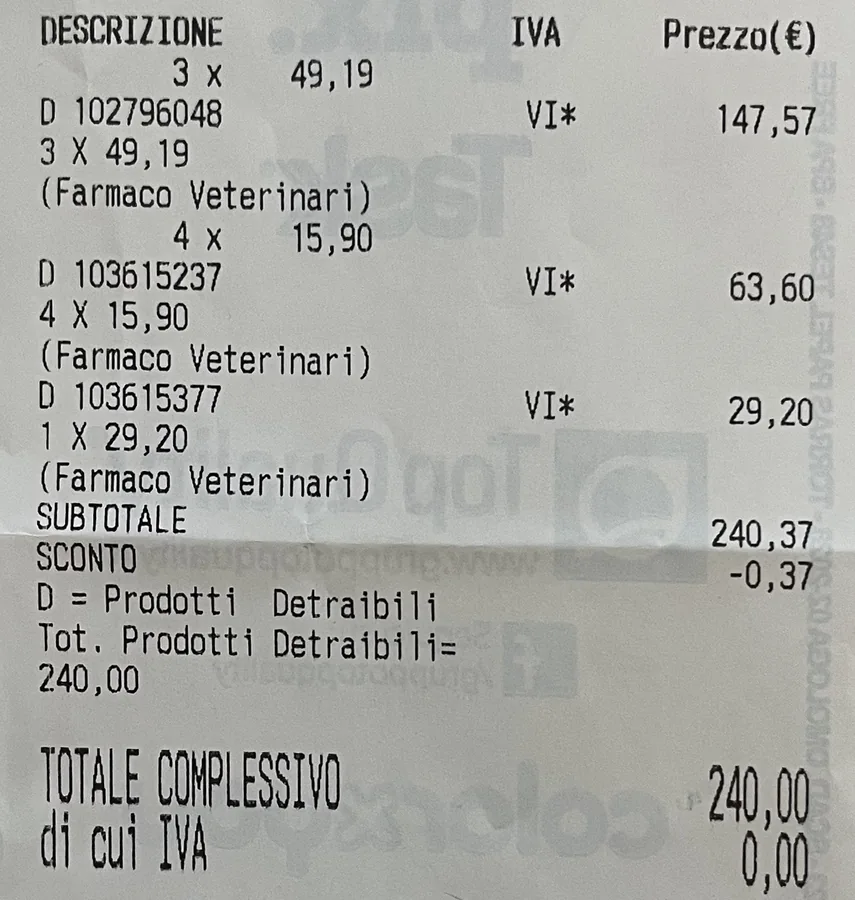
| Preventive worming of the bitch, Milbemax | €29.20 |
Progesterone testing is how you find the right day: without it you mate at random and lose a season. Four tests are the minimum, and more are often needed.
The stud dog
When the stud is not at the kennel — and in our case he never is, for the reasons explained in the guide to parents on site — you pay a stud fee.
It ranges from €700 for a young dog, perhaps without titles, up to €1,600, which is what we were asked for a Junior World Champion in Hungary, an Elitebull dog.
On top of that comes the journey, which depends on the distance, and often a night in a hotel: there are two matings, 12 to 24 hours apart, and you do not go home in between.
The pregnancy
| Item | Cost |
|---|---|
| Ultrasound 25 days after the second mating | €35-40 |
| Ultrasound and X-ray a week before whelping | €50-80 |
| Puppy kibble for the bitch | €60 per 12 kg |
The ultrasound tells you whether she is pregnant. The final X-ray, once the skulls have calcified, tells you how many puppies there are: during whelping it tells you when it is over, and the ultrasound on the same day flags any puppy in distress.
Puppy kibble costs a good deal more than maintenance food, and a nursing bitch eats a lot of it.
The whelping
A natural whelping costs nothing, apart from oxytocin if it is needed, about €30.
A caesarean costs between €500 and €800, depending on the day and the time: at night or on a Sunday it sits at the top of the range. You do not choose: either it is needed or it is not.
After the birth
| Item | Cost |
|---|---|
| Milbemax for the bitch | €29.20 |
| Milbemax for the puppies, four packs for eight puppies | €63.60 |
| Panacur for the puppies, six-day course | €147.57, three packs of ten tablets: the most expensive item in the group |
| ENCI litter registration, form A | €60 |
| Form B, for each puppy | €25 |
Worming is repeated several times, and the cost grows with the number of puppies. On top of this come the laboratory faecal test, the first vaccinations, the microchip and the veterinary check-ups.
The pharmacy receipt with these three items is at the top of the page; the full receipt is available as a PDF, with the tax code covered.
The total
For a litter of six puppies, with no complications and a young stud dog:
around €2,000, before vaccinations, microchips and laboratory tests.
With a top-level stud dog, the trip abroad and a caesarean:
well over €4,000.
And this does not include the genetic tests on the breeding dogs, paid once per dog — about €400 per breeding dog for the sample, the laboratory and the shipping — nor the time: nights on the sofa next to the whelping box, the daily weighing, the journeys.
These figures are not here to justify a price. They are here to show why a litter sold at a few hundred euros a puppy cannot have any of this behind it.
Why cheap puppies cost more
Let us do the arithmetic.
A litter done properly, as we saw above item by item, costs about 2,000 euros: with six puppies that is more than 330 euros a puppy, before vaccinations, microchips and tests. With a stud dog abroad and a caesarean it goes past 650. A puppy sold for a few hundred euros is below the cost of a serious litter. How is that possible?
By cutting everything:
- No genetic testing (around 400 euros per dog once sampling and shipping are counted)
- Supermarket kibble instead of quality food
- Few vaccinations, or none
- No pedigree, or a false one
- No contract, no guarantees
- No selection at all: dogs are put together at random to produce puppies
The bill arrives later:
A dealer’s puppy can look healthy at 8 weeks. The problems surface afterwards:
- L2HGA: a neurological disease that appears between 6 months and a year. No cure. Fatal outcome.
- Hereditary cataract (HC): progressive blindness
- Behavioural problems: unsocialised dogs that develop fears, aggression, separation anxiety
- Physical defects: dysplasia, breathing problems, incorrect conformation
Surgery for hip dysplasia costs 3,000-5,000 euros. Managing a dog with serious behavioural problems is harder to price: trainers, medication, and a compromised quality of life for everyone involved.
The puppy that cost little can easily become a dog that costs thousands in veterinary care.
The difference you cannot see in the price
The price of a puppy does not just pay for vaccinations and a pedigree. It pays for an entirely different way of breeding.
| Breeding for numbers | Breeding for selection | |
|---|---|---|
| Where the puppies live | Pens, cages, a garage. They see the breeder when food arrives | In the house, with the family. By eight weeks they have already heard the vacuum cleaner and met children and visitors |
| How they are looked after | As many litters as possible, as little expenditure as possible | Every dog is walked on its own. It knows the village, the people, the noises |
| What they eat | The cheapest kibble available | Food calibrated for growth, because the first months weigh on the whole of a dog's life |
| The selection | Whatever is available gets mated, as long as it is the breed | Studied pedigrees, complementary lines, breeding dogs tested and often titled |
How to recognise a dealer
Some warning signs:
| Area | Warning signs |
|---|---|
| Figures | Well below the breed average; discounts for deciding at once; a different figure "with or without pedigree", which is not an optional extra |
| How they talk to you | They do not want you to see where the dogs live; they ask you nothing about your home, family and experience; they always have puppies of every age; they rush you |
| Documents | They do not show the parents' tests, or say they are not needed; the pedigree is "on its way"; no written agreement |
| The dogs | You cannot see the mother with the puppies; the parents look frightened or aggressive; too many females and too many litters |
If even one of these signs is present, walk away.
What a serious breeder is actually worth
When you buy from a serious breeder, you are not only buying a puppy. You are buying:
Experience in the breed. Years of selection, of studying pedigrees, of knowing the bloodlines. Knowing how to match temperaments and anticipate how puppies will grow.
Proven parents. The breeding stock is not only genetically tested. These are dogs that live in the family, whose character is known in every detail, and which have often already shown they produce quality.
Lifetime support. When you have a problem, a doubt, a question — even ten years later — you can call. You are never on your own.
A real guarantee. If something goes wrong, the breeder is there. A dealer disappears once the transfer clears.
In closing
A properly bred Staffordshire Bull Terrier puppy is never the cheapest on the market. It is a fair price for a healthy, balanced, well-socialised dog, with all its paperwork in order and a breeder who stays with you.
Cheap puppies exist, but the saving is only apparent. What you do not pay at the start, you pay later — in vets, in problems, in distress.
We give our price on the phone. Not to be mysterious, but because we would rather first explain how we work: which tests we run and why, how the puppies are raised, what the placement includes and what happens afterwards. These are things worth talking through, not reading in a single line.
Choose with your head, not your wallet. If you want to see how we work, visit our Staffordshire Bull Terrier puppies page.
See also: how to choose a serious breeder.
Want to know more about our puppies and upcoming litters? Write to us on WhatsApp — we will tell you how we work and answer any question.