20 Questions & Answers
Frequently
Frequently
Asked
Questions
Everything you want to know about the Staffordshire Bull Terrier
FAQ
Your Questions, Our Answers
Welcome to the FAQ section of Del Piccolo Diavolo Kennel.
If you have questions not found here, contact us on WhatsApp.
Is the Staffordshire Bull Terrier dangerous or aggressive?
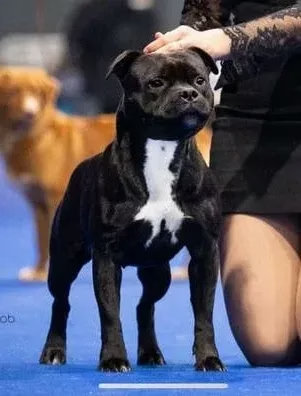
The Staffordshire Bull Terrier is not on any list of dangerous breeds in Italy: the list of at-risk breeds was abolished in 2009 by the Ministry of Health, which moved responsibility from the breed to the owner. It is a powerful dog for its size — 35-40 cm at the withers and 12-17 kg in males — and that is worth keeping in mind, but dangerousness is not a breed trait: it depends on how temperament is selected, on socialisation in the first weeks, and on how the dog is handled for the rest of its life. The trait genuinely worth knowing about is different: being a terrier, it can show reactivity towards other dogs, most often of the same sex in adulthood. Towards people the breed standard describes a reliable dog, and there the choice of breeding stock matters more than anything else.
Is the Staffordshire Bull Terrier suitable for children?
First, something that applies to every breed: no dog should be left alone with a small child. The nickname "nanny dog" describes the Staffy's tolerance, not an ability to supervise: an adult present is not optional. That said, this is a dog built to live in a family, and how it grows up in the first weeks matters enormously — our puppies are among people of all ages from the start. What makes the difference is the selection of the parents, those first eight weeks, and the rules the family sets at home: a place where the dog is never disturbed, short interactions, and an adult always in the room.
How much does a puppy with ENCI pedigree cost?
There is no price list: what you pay reflects costs that exist before the puppies are even born. Genetic tests on both parents for L2HGA, HC and PHPV are paid once per dog and last their whole breeding career. Registering the litter with the ENCI stud book has published fees, the same for everyone. Add veterinary visits during pregnancy, the ultrasound at around day 25, the X-ray before whelping, first vaccinations, worming and the microchip. A very low price almost always means something is missing: the tests, the pedigree, or puppies separated from their mother before the 60 days required by Italian law. Every puppy leaves with vaccinations, microchip, worming, the parents' test certificates and our support for the dog's whole life.
What genetic tests do you perform on breeding dogs?
All our breeding dogs are tested for L2-HGA, L-2-hydroxyglutaric aciduria, a neurological disease; HC, juvenile hereditary cataract; and PHPV, a congenital eye anomaly. The first two are established with a DNA test, the third with a specialist ophthalmological examination. All three are recessive: two clear parents cannot produce affected puppies. Carriers are not used for breeding here. The laboratory reports are published on this site and can be downloaded, with the dog's microchip number in plain sight: that number is what makes the document verifiable, because without it the report could refer to any dog at all.
At what age can I take the puppy home?
Puppies are placed after 60 days of age: that is the minimum Italian law allows, and here they usually stay until 70. For families adopting from another European country the timing is different: the puppy leaves at around four months, because the rabies vaccination, the pet passport and the TRACES certificate are all needed (how a placement abroad works). This period is essential: in the first 8 weeks the puppy learns from the mother the basics of canine communication and self-control. Placing earlier is illegal and harmful.
Does the Staffy get along with other dogs?
It depends on the individual, and it needs saying plainly: this is a terrier, and the breed carries a degree of reactivity towards other dogs that socialisation reduces but does not erase — most often between dogs of the same sex, in adulthood. Early socialisation is still the best foundation. Our puppies grow up in contact with other balanced adult dogs, learning proper communication. With early and continuous socialization, the Staffy is sociable and playful. Many of our Staffies live happily with other dogs.
Difference between Staffy and Amstaff?
They are two distinct breeds recognised by the FCI, with separate standards and stud books. The Staffordshire Bull Terrier is the smaller of the two: 35-40 cm at the withers and 12-17 kg in males, with a short broad head and a compact build. The American Staffordshire Terrier is larger and leaner: 46-48 cm and 25-30 kg, with a longer muzzle. The difference is not only size: these are two selections separated by more than a century, one English and one American, with lines that do not cross. The Pit Bull, often confused with both, is not a recognised breed in Italy and no ENCI pedigree certifies one.
How long does a Staffordshire Bull Terrier live?
Twelve to fourteen years, which is a good life expectancy for a medium-sized dog and among the best in the molosser group. The breed is robust, without the respiratory problems of extreme brachycephalics and without the joint conditions typical of large breeds. The three known hereditary diseases — L2-HGA, hereditary cataract and PHPV — are all recessive and are prevented by testing the parents: two clear dogs cannot produce affected puppies. After genetics, the single factor that most affects lifespan is weight: an overweight Staffy ages earlier, with joints that wear out and less tolerance to heat. Twelve years is also the commitment you take on when you choose a puppy.
How to recognize a serious breeder?
By what can be verified without having to trust anyone. Genetic test reports only count if they carry the dog's microchip number: without it the document cannot be linked to any particular animal. Pedigrees can be checked on SBTPedigree, the breed's international archive. The number of litters a bitch has had can be looked up in the ENCI stud book, again starting from the microchip. Show results appear in the public catalogues of the events, with the judge's name. A breeder who receives by appointment and shows you the mother and the place where the puppies grow up is another good sign, as is respecting the 60-day minimum before rehoming, which is a legal requirement in Italy.
What nutrition does the Staffy need?
The Staffordshire Bull Terrier is a muscular and greedy dog, and that combination leads easily to excess weight. A sound diet means good-quality kibble with protein around 26-30 per cent, or a home-cooked or raw diet balanced by a veterinary nutritionist: what matters is not the formula but consistency and quantity. Ideal weight is 14-16 kg for males and 11-14 kg for females, and it is checked with your hands before the scales: ribs should be easy to feel without pressing. Puppies eat three times a day until six months, then twice. Treats between meals are the most common cause of overweight in this breed, far more than the brand of food.
Can I visit the kennel?
Yes, and it is the right way to get to know us. Del Piccolo Diavolo is in Ostellato, in the province of Ferrara, and receives by appointment only, so that we can give you all the time you need without stressing the dogs. During the visit you see the adult dogs and the mother of the litter, the place where the puppies are born and grow up, and you can check pedigrees and test reports in person. It is also the moment when we ask you a few questions: how many hours the dog will be alone, who is at home, what happens in summer. It is not an interrogation, it is how we work out whether that puppy and that family fit. Anyone taking one of our puppies comes here: we do not ship dogs.
Does the Staffy need a lot of exercise?
It needs regular exercise, not extreme exercise. Two walks a day of thirty to forty minutes cover an adult's needs, provided at least one allows sniffing and free movement rather than a march on a tight lead. The Staffordshire Bull Terrier is explosive rather than built for endurance: it performs on short intense efforts, not hours of running. The part most people underestimate is mental work: half an hour of scent games tires a dog as much as an hour of running, without loading the joints. For puppies the usual rule is five minutes per month of age per walk, because growth plates close between twelve and eighteen months.
Does the Staffy shed a lot?
It sheds little, but it does shed. The coat is short, smooth and has no undercoat, so there are none of the heavy moults of double-coated breeds and no professional grooming is needed at all. The hairs that come out are short and stiff and tend to work their way into fabric: one weekly brush with a rubber mitt collects them before they reach the sofa. Baths are rarely needed, every two or three months or when the dog is genuinely dirty, because washing too often dries the skin. The flip side of the short coat is temperature sensitivity: a coat for long winter walks, shade and water in summer.
Is it difficult to train a Staffy?
It is an intelligent dog, strongly oriented towards people, which makes training easier than in many breeds — but it also carries a typically terrier streak of stubbornness. It responds very well to positive reinforcement and very badly to coercive methods, which at best shut it down and at worst create problems that were not there before. Basic commands come quickly. The two things worth working on from day one are the recall, because a terrier that sets off after something stops hearing you, and impulse control, because this is a dog that gets excited easily. Consistency beats duration: five minutes every day beat an hour on Sunday.
Can the Staffy live in an apartment?
Yes, and often it does better there than in a garden. The Staffordshire Bull Terrier is deeply attached to its family: left outside on its own it gets bored and low, while in a flat it is where the people are, which is all it really wants. What matters is not square metres but walks: two a day, with a chance to sniff and stretch. It also helps that this breed barks little, which in a block of flats removes the most common source of complaints. A garden is convenient for quick toilet breaks but does not replace the walk, and a dog that only goes out into the garden loses its habituation to people and noise.
What is the typical Staffy character?
The breed standard describes a dog that is bold, tenacious and reliable with people, and what strikes owners most is the attachment: this is a dog that wants to be wherever you are. It stays playful into adulthood, is often comical, and with children it is tolerant — always with an adult supervising, as with any breed. The other side of that attachment is that it copes with loneliness less well than many dogs. Towards other dogs it must be said plainly that it is a terrier: reactivity can appear, most often between dogs of the same sex in adulthood, and early socialisation reduces it but does not erase it.
Does the Staffy bark a lot?
No, it is one of the quieter breeds in its group, which matters a great deal in a block of flats. It is not a watchdog and does not bark out of habit: it signals something new at the door and then stops. When a Staffy does bark a lot, the problem is usually not the breed but the situation — boredom, too little exercise, or long periods alone. In that last case barking can be a symptom of separation anxiety, which is a recognised disorder and not misbehaviour, and is treated with a gradual programme and professional help. Telling off a dog that barks from anxiety makes the anxiety worse.
Can I leave the Staffy home alone?
Yes, but it has to be taught gradually and not for long stretches. This breed is very attached to people, so it tolerates solitude worse than many dogs: four or five hours is a reasonable limit for a settled adult, while a puppy will not manage more than a couple. The habit is built from the first day with very short absences, extended little by little, and with no drama either on leaving or on returning. The warning sign is not mess but panic: continuous vocalising, drooling, attempts to get through the door. That is separation anxiety, and it is worth involving a professional rather than waiting for it to pass.
Does the Staffy suffer from heat or cold?
Yes, to both, and for the same reason: the coat is short with no undercoat, so it does not insulate. In winter, below about five degrees, a coat is worth having for long walks, especially for puppies and older dogs. Summer is the more serious issue, because the shortened muzzle makes panting — the dog's only real cooling system — less efficient than in a long-muzzled breed. Above 25 degrees walk in the cool hours, reduce intensity and carry water. Never leave the dog in a car, not even briefly and not even with windows ajar: heatstroke is a veterinary emergency.
How much does it cost to maintain a Staffy per year?
Around 300 to 500 euros a year for routine costs: good-quality food, annual veterinary check-ups and boosters, monthly parasite treatment and equipment. Grooming is not needed at all, since the short coat requires nothing beyond a weekly brush — in other breeds that is a substantial line. Two things sit outside that figure. Third-party liability insurance, a few tens of euros, which is worth having in any case. And unexpected costs: an investigation, an operation, a long course of treatment. Nobody can predict them, but over twelve to fourteen years they arrive, and it is honest to budget for them before taking a puppy rather than after.
Have More Questions?
We're always available to answer any questions about the Staffordshire Bull Terrier.
Write Us on WhatsApp