The Staffordshire Bull Terrier character: the truth
I met my first Staffordshire Bull Terrier in 2005 at Crufts. In the breed since 2005, breeding since 2013: since then I have bred, raised and rehomed over a hundred of them. I know this breed in a way that no generic article can match.
The Staffy is the most affectionate dog that exists. That's not rhetoric — it's something anyone who has ever lived with a Staffordshire Bull Terrier will confirm immediately. This dog has a physical need for human contact — it wants to stay close to you, sleep with you, follow you into every room.
But there's a second side: the Staffy is also a dog with a very strong personality. It's determined, stubborn, full of energy. It's not a passive dog that's content to exist in a corner. It wants to participate, wants to play, wants to be involved in everything you do.
The combination — extreme affection plus strong character — is what makes the Staffy unique. And also what makes it unsuitable for those looking for an "easy" dog in the wrong sense of the word.
With children: the "nanny dog" is not a myth
In England they have called it the "nanny dog" for centuries. It's not marketing — it's a real characteristic, genetically selected. The well-bred Staffordshire Bull Terrier has a patience with children that few other breeds can match.
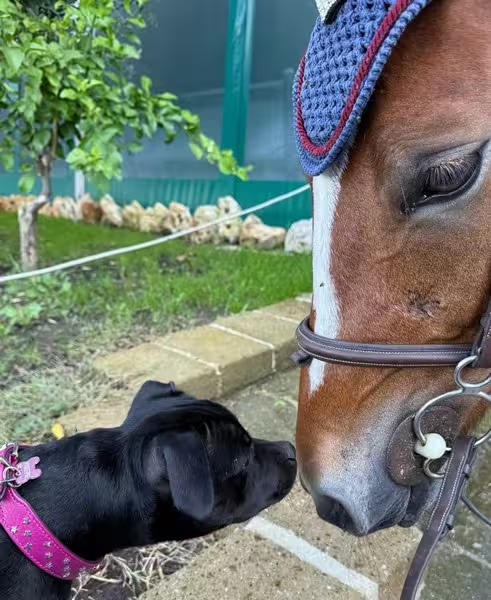
I have seen my Staffies tolerate small children pulling ears, jumping on them, disturbing them during sleep. Not because they were passive — because they were balanced. There is an enormous difference.
That said: no dog is infallible. Supervision is always necessary, especially with very young children. The Staffy doesn't bite out of aggression, but can cause unintentional harm due to its exuberance and physical strength.
⚠️ Supervision Always Required
Regardless of breed, no dog should ever be left alone with young children without adult supervision. This applies to the Staffy as much as to the Labrador or any other breed.
With other dogs: socialisation is everything
This is the point where I need to be honest. The Staffordshire Bull Terrier has a historical background as a fighting dog — it cannot be ignored. In some individuals, especially unneutered males, intolerance towards other dogs of the same sex may emerge.
The good news: with early and continuous socialisation, the vast majority of Staffies live happily with other dogs. All of mine live in a group without problems. But it requires consistent work, especially in the first months of life.
When asked "can I keep it with another dog?" my answer is always the same: it depends on the individual dog, the character selection and how much you invest in socialisation. It's not a simple answer because the reality isn't simple.
Energy and exercise: how much is really needed
The Staffy is an athletic dog with considerable energy — but it's not a Border Collie. It doesn't need to run for hours a day to be balanced. It needs regular physical activity, mental stimulation and above all human interaction.
What wears out a Staffy most is not lack of physical exercise: it's boredom. A dog left alone in the house all day without stimulation becomes destructive not out of malice but out of frustration.
📋 What Does an Adult Staffy Need?
Walks: 2 per day, 30-40 minutes each
Play: daily active interaction sessions
Human presence: essential — suffers from prolonged solitude
Mental stimulation: intelligence games, commands, varied activities
In an apartment: does it work?
Yes, it works — with the right conditions. The Staffy is not a garden dog: it's a sofa dog. It prefers to be inside with the family rather than outside alone. An apartment works perfectly if the owner is present and active.
What doesn't work is leaving a Staffy alone in an apartment for 10 hours a day. This applies to almost all breeds, but for the Staffy — which has a particularly strong human attachment — it's even more problematic.
Pros and cons: the honest list
Pros
- Unmatched affection and loyalty
- Exceptional patience with children
- Intelligence and eagerness to learn
- Short coat — minimal grooming
- Robust and long-lived (12-14 years)
- Adaptable to apartment living
- Presence that deters intruders without aggression
Cons
- Suffers from loneliness more than other breeds
- Can be stubborn during training
- High physical strength — requires work on the lead
- Possible intolerance towards other dogs of the same sex
- Energetic: not suitable for sedentary owners
- Destructive if bored or left alone too long
Character selection: why it matters more than the breed
A Staffy's character depends 60% on genetics and 40% on environment. This means that choosing a serious kennel — one that selects breeding dogs with stable character and socialises puppies from day one — is the most important decision you can make.
A puppy born from parents with unstable character, raised in an isolated kennel, arrives in its new family with an enormous disadvantage that no training can fully compensate for.
At our kennel we select for character before aesthetics. If you're looking for Staffordshire Bull Terrier puppies with a solid character from birth, this is where it starts. To find out how we select our breeding dogs, read our breeding programme.
🐾 Considering a Staffy?
Contact me before deciding. I answer all questions and help you understand if the Staffy is really right for you. Write to me on WhatsApp.
Frequently Asked Questions about the Staffy's Character
Answers based on 20 years of direct experience