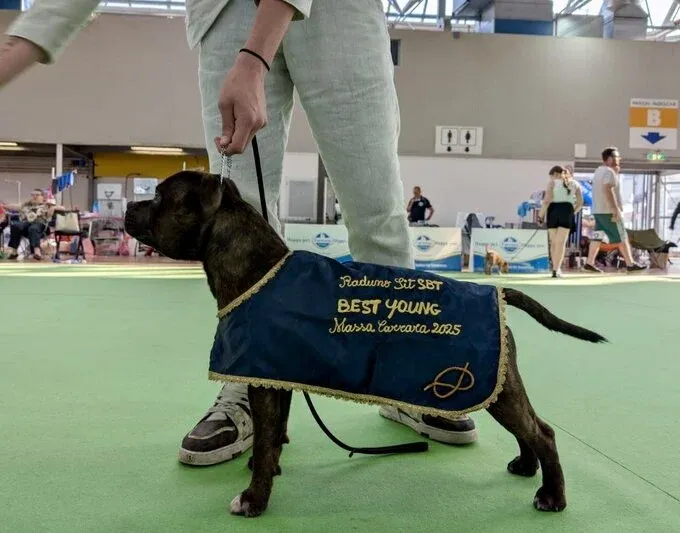
Why Are These Breeds Confused?
The confusion between Staffordshire Bull Terrier, American Pit Bull Terrier and American Staffordshire Terrier is extremely common, not only among laypeople but also in the media and sometimes in institutions. This confusion has concrete consequences: poorly written laws, unjustified prejudices and difficulties for owners.
All three breeds descend from the same stock: the "Bull and Terrier" dogs of 19th century England, crosses between Bulldogs and various Terriers. They therefore share a common genetic heritage and some similar morphological characteristics: broad head, powerful jaw, muscular body.
The media tend to use the generic term "Pitbull" to indicate any "bull" type dog, regardless of the actual breed. When a molosser-type dog is involved in an incident, the breed is rarely correctly identified, fueling generalized stereotypes.
Historical Origins: A Common Ancestor
19th Century England: Bull and Terrier
In the 19th century, animal fights were popular in England. The Bull and Terrier were born from crosses between Bulldogs (strength, grip) and Terriers (agility, tenacity). These dogs were used for "bull-baiting" and later, after the 1835 ban, for dog fights.
Staffordshire Bull Terrier: The British Breed
The Staffordshire Bull Terrier developed in the Staffordshire region of England. In 1935 it was officially recognized by the British Kennel Club. The FCI recognizes the Staffordshire Bull Terrier with standard n. 76, in Group 3 (Terriers), Section 3 (Bull type Terriers).
American Breeds: Pit Bull and Amstaff
American Pit Bull Terrier (APBT): Recognized by the UKC (United Kennel Club) in 1898 and by the ADBA. The APBT is NOT recognized by the FCI or the AKC.
American Staffordshire Terrier: In 1936, the AKC recognized a "show" version of American Pit Bulls with the name "Staffordshire Terrier", later renamed "American Staffordshire Terrier" in 1972. The FCI recognizes it with standard n. 286.
Physical Comparison: Table of Differences
| Characteristic | Staffordshire Bull Terrier | American Pit Bull Terrier | American Staffordshire Terrier |
|---|---|---|---|
| Height males | 35.5 - 40.5 cm | 45 - 53 cm | 46 - 48 cm |
| Height females | 35.5 - 40.5 cm | 43 - 50 cm | 43 - 46 cm |
| Weight males | 12.7 - 17 kg | 15 - 27 kg | 25 - 35 kg |
| Weight females | 11 - 15.4 kg | 13 - 23 kg | 20 - 30 kg |
| FCI Recognition | ✅ Standard n. 76 | ❌ Not recognized | ✅ Standard n. 286 |
| Country of origin | Great Britain | United States | United States |
How to Distinguish Them by Sight
The Staffordshire Bull Terrier is the smallest and most compact. It has a broad, short head relative to the body, with very pronounced cheeks. Maximum weight 17 kg. It is the only one with never cropped ears.
The American Pit Bull Terrier is medium-sized, taller and slimmer than the Staffy. It has an athletic body, built for agility rather than mass. Very variable weight (15-27 kg).
The American Staffordshire Terrier is the largest and most massive. It has a very broad head, robust and muscular body. Weight up to 35 kg in males.
Character and Temperament Differences
Staffordshire Bull Terrier
The FCI standard describes the Staffy's temperament as: "Traditionally of indomitable courage and tenacity. Highly intelligent and affectionate, especially with children." The Staffy is known for its strong attachment to the human family, so much so that it has been nicknamed "nanny dog".
American Pit Bull Terrier
The APBT has been historically selected for "gameness" (tenacity, determination) and athleticism. The UKC standard describes it as "strong, confident, with enthusiasm for life".
American Staffordshire Terrier
The Amstaff, selected for shows, tends to have a slightly calmer temperament than the APBT. The AKC standard describes it as "good with children, reliable, trustworthy".
Which Breed to Choose?
If your choice is narrowed to Staffy or Amstaff, we have a guide dedicated to that comparison: which of the two breeds suits you.
Choose the Staffordshire Bull Terrier if:
- You want a medium-small dog (max 17 kg) manageable in an apartment
- You are looking for a dog with pedigree and breeding guarantees
- You have children: the Staffy is traditionally excellent with little ones
- You want an energetic but not "extreme" dog
- You prefer a breed with fewer legal and insurance issues
Choose the American Staffordshire Terrier if:
- You prefer a larger and more imposing dog (up to 35 kg)
- You still want a recognized pedigree
- You have experience with "bull" type dogs
- You have adequate space (garden or possibility of lots of exercise)
🏆 Our Advice
At our Del Piccolo Diavolo kennel we have chosen to dedicate ourselves exclusively to the Staffordshire Bull Terrier: it is a breed with clear FCI standard, allows controlled selection with genetic tests (L2-HGA, HC), has ideal size for modern family life and an exceptional temperament. Our puppies come from documented English and Irish bloodlines.