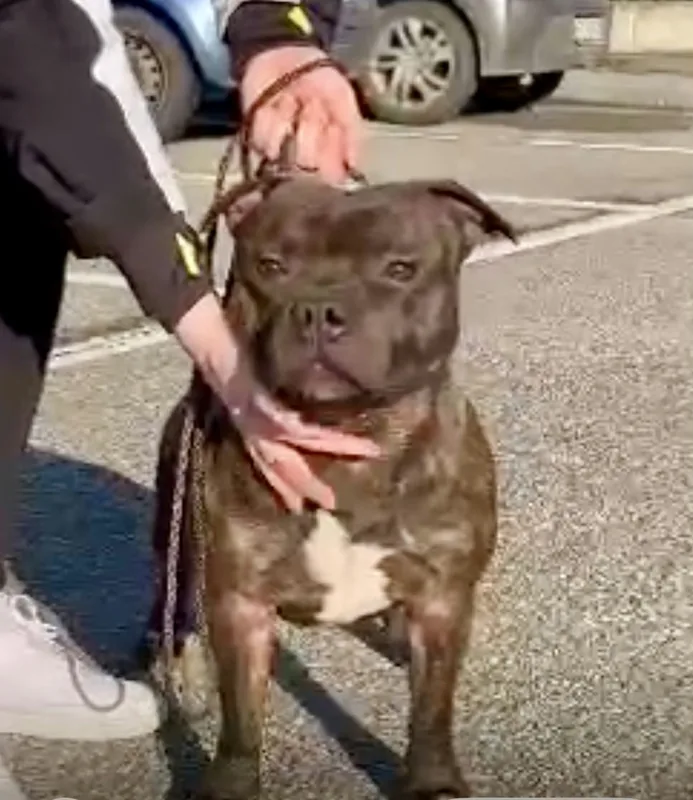
The temperament of the Staffordshire Bull Terrier is no accident: it is the result of deliberate selection and of the first weeks of life. The breed standard describes a dog that is bold, tenacious and reliable with people, and on that last point the choice of breeding dogs weighs more than any later training. The trait worth asking about is a different one: as a terrier, it can be reactive towards other dogs, especially between adults of the same sex, and early socialisation reduces this without removing it. Temperament is judged by looking at the parents and littermates, not at a single puppy at three weeks. A guide by the Del Piccolo Diavolo kennel, which has bred Staffordshire Bull Terriers in Ostellato (Ferrara, Italy) since 2013.
A character that was built, not inherited by chance
The Staffordshire Bull Terrier emerged in England in the first half of the nineteenth century, in the Midlands, from crosses between the bulldogs of the day and local terriers. The context in which these dogs were used is not the part we like to tell, but it is the part that shaped their character, and ignoring it means misunderstanding the breed.
These dogs lived indoors, often in small and crowded houses, and were handled constantly: separated, lifted, treated bare-handed even when excited or injured. In those conditions a dog showing the slightest aggression towards a person was an immediate danger to the household, and it was removed from breeding without discussion.
Repeated across generations, that selection produced something rare in the dog world: a breed in which reliability towards humans is not a training objective but a genetic starting point. It does not mean every Staffy is born perfect. It means the predisposition runs deep.
What the standard actually says
The Kennel Club describes the temperament of the breed in three words: bold, fearless and totally reliable.
That last phrase deserves attention, because it is almost unique. Very few breed standards use a word like "reliable" about the relationship with people: most speak of alertness, reserve with strangers, guarding instinct. Here reliability is stated as a constitutive trait.
The standard adds highly intelligent and affectionate especially with children. It is from this wording that the "nanny dog" nickname comes, an expression to handle with care — we deal with everyday life in the guide on family living, where the subject is treated at length.
The other side: tenacity
The same selection that produced reliability towards people preserved another quality: tenacity. A dog that faced a hard job without backing off was a dog that got bred.
Today that tenacity appears in entirely peaceful forms — in play, in the insistence with which the dog follows you around the house, in the determination it brings to a food puzzle. But it also exists in a version that needs managing: tolerance towards other dogs is not guaranteed, particularly between animals of the same sex after social maturity.
It is a predictable trait, not a hidden defect. And it should be said before the puppy goes home, not after: anyone looking for a dog to take to the park and let loose with all comers needs to know this in advance.
What we select for, in practice
In our kennel character is not an aspiration but a criterion for exclusion. A dog showing marked insecurity, excessive reactivity or wariness of people does not enter the breeding programme, however correct its conformation.
The reason is practical: conformation can be corrected in two or three generations by choosing partners well, character cannot. A temperament fault propagates for many generations and shows itself in family homes, not in the ring.
It also means giving up, sometimes, on beautiful dogs. That is the cost of honest selection.
How temperament is assessed in a puppy
At eight weeks you cannot read the adult character, but you can observe tendencies. Three things are more telling than the rest.
Recovery after a surprise. Drop an object at a distance: almost every puppy startles. What matters is what happens next — a balanced puppy is back to exploring within seconds, an insecure one stays frozen or withdraws.
The approach to a stranger. A moment of hesitation is normal and healthy. What you want to see is that after hesitating the puppy comes forward. The ones that never approach, and the ones that launch themselves with no assessment at all, sit at the two extremes.
Tolerance of handling. Held on its back for a few seconds, a balanced puppy struggles briefly and then relaxes. Panic or complete rigidity are signals worth noting.
The most common mistake families make is choosing the boldest puppy, the one that arrives first. For most families the secure middle of the litter works better than either extreme. A good breeder knows this and proposes the match: if they do, it is a sign of seriousness, not an imposition.
How much the breeder weighs against the breed
The breed defines a range; the breeder decides where within that range you land. Two Staffordshire Bull Terriers with comparable pedigrees on paper can have noticeably different temperaments, depending on what was selected for and how the first eight weeks were spent.
Those weeks, incidentally, are half the socialisation window: what a puppy meets between the third day of life and going home becomes part of its normal world. A puppy raised in a kitchen, among domestic noise and visitors, arrives at your house with an advantage that cannot be recovered later.
That is why, when you are assessing a kennel, the questions about character count as much as the ones about genetic testing.
Guides for those looking for a kennel in Italy
Would You Like to Meet Our Staffies in Person?
The best way to understand the character of a line is to meet the adult dogs. Write to us to arrange a visit.
Write to Us on WhatsApp