Black, brindle, fawn, blue and pied: which are allowed and what to know
📅 August 2026⏱️ 8 min read
FCI StandardBlackBrindleFawn and RedDiluted BlueWhite and PiedHealthFAQFCI StandardBlackBrindleFawn and RedDiluted BlueWhite and PiedHealthFAQ
In short: the Staffordshire Bull Terrier standard allows the colours red, fawn, white, black or blue, each with or without white, and any shade of brindle with or without white. Black and tan and liver are not permitted. Blue, although listed in the standard, is a diluted colour linked to possible skin problems: serious breeders treat it with great caution. In this guide we explain each colour clearly.
What the official standard says
FCI standard no. 76 for the Staffordshire Bull Terrier lists the permitted colours precisely. Allowed are:
Red
Fawn
White
Black
Blue
Each of these with or without white
Any shade of brindle, with or without white
The standard is equally clear about what is not permitted: black and tan (black with brown markings) and the liver colour. A dog of these colours, though it may be an excellent companion, does not conform to the breed standard.
Black — elegant and always in style
Solid black is one of the most loved and striking colours of the breed: a smooth, glossy, even coat that highlights the Staffy's typical musculature. It can appear as solid black or black with white (markings on the chest, toes, muzzle).
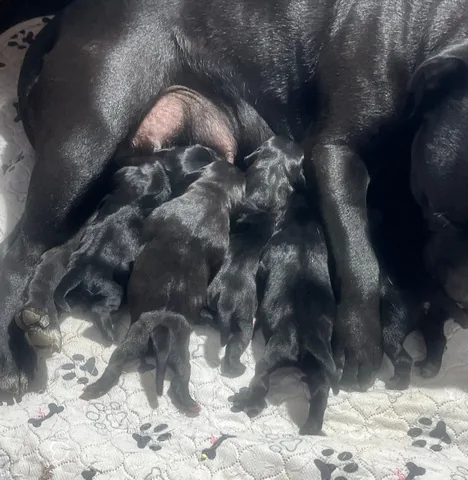
It is a colour that fully conforms to the standard and is much sought after. Our current litter is in fact an all-black litter.
Our black puppies from the Bilquis × Black Jack litter (August 2026).
Brindle — the timeless classic
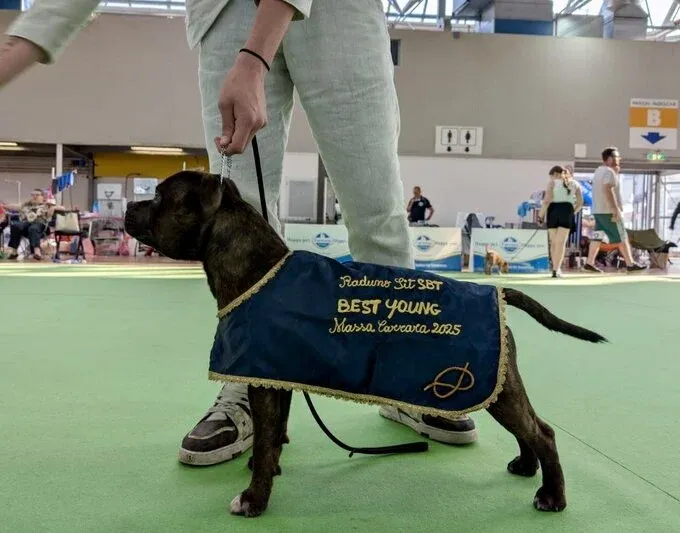
Brindle is perhaps the most iconic colour of the Staffordshire Bull Terrier: a fawn or reddish base crossed by dark striping, in endless shades. The standard allows any shade of brindle, from light to very dark (so-called "black brindle", so heavy it looks almost black).
It can be solid brindle or brindle and white (with markings). It is a colour full of charm and deeply tied to the history of the breed.
Fawn and red — from honey to copper
Fawn covers the shades from cream/honey to golden beige, while red ranges from copper to an intense brick tone. Both are allowed with or without white. They are warm, bright colours, much appreciated. These dogs often have a darker facial mask.
White and pied
White is allowed, as are all colour + white combinations. Predominantly white dogs with coloured patches are often called pied. They conform to the standard and can be very striking.
The blue case: beauty and caution
Blue is a slate-grey that comes from a dilution gene acting on black. It is present in the standard, so it is an allowed colour. However, it should be understood for what it is, honestly.
The diluted gene that produces blue is associated, in a proportion of dogs, with colour dilution alopecia (CDA), a skin condition that can cause hair loss and dermatitis. Not all blue dogs suffer from it, but the risk exists and is linked precisely to the dilution.
For this reason serious breeders treat blue with great caution and avoid matings between two diluted dogs (blue × blue), considered problematic from a health point of view. Be wary of anyone who promotes blue as a "rare and precious colour" at a high price while ignoring the health aspects: health comes before aesthetics.
🏆 Our approach to colours
At our Del Piccolo Diavolo kennel the choice of breeding dogs always starts from health and breed type, not from the "fashion" of a colour. We select colours that conform to the standard, with parents tested for L2-HGA and HC, and we avoid risky diluted matings. A lovely colour on a healthy, typey dog is worth infinitely more than a "rare" colour obtained at the expense of welfare.
Does colour affect temperament?
No: this is a myth to dispel. The coat colour has no relationship with the temperament of the Staffordshire Bull Terrier. A black, brindle or fawn dog can be equally sweet and balanced. Temperament depends on the parents' genetics, on socialisation and on how the puppy is raised — not on the shade of the coat.
Frequently Asked Questions
What is the rarest Staffordshire Bull Terrier colour?
Among the colours permitted by the standard, the hardest to find are blue brindle and a well-defined fawn with a black mask. Rarity, though, should be read for what it is: a matter of gene frequency in the lines, not an index of value. A rare colour does not make a dog healthier, better or more typical, and when a kennel builds its marketing on colour rather than on temperament, health and structure, something is off. It is also worth knowing that some colours marketed as exotic are excluded from the standard precisely because they signal crossbreeding: merle, for instance, does not exist in the breed.
Is black and tan permitted?
No. The breed standard explicitly excludes black and tan and liver, and the reason is not aesthetic: those colours are historically associated with crosses to other breeds, so their presence casts doubt on the purity of the line. A black and tan puppy can still be born to two pedigree parents, because the gene can stay hidden for generations, and such a dog is no less healthy and no less affectionate: it simply cannot be used for breeding and cannot be shown. A serious breeder says so openly instead of selling it as a rare colour at a premium, which is exactly what happens elsewhere.
Is a blue dog less healthy than the others?
Blue is permitted by the standard, so it is not a fault in itself. What deserves attention is that the dilution gene, across many breeds, comes with a higher frequency of colour dilution alopecia, a condition causing thinning coat and recurrent dermatitis, usually appearing between six months and three years. Not every blue dog develops it, but the risk is higher than in non-diluted coats. The real problem arises when breeders select for the colour: mating two blues simply to produce blue puppies concentrates the dilution and the risk with it. Colour should be a consequence of a mating, never its objective.
Does the coat colour change as the dog grows?
Yes, often considerably. Brindle is the clearest case: many puppies look almost black and only develop their striping after some weeks, as the coat lengthens and lightens. Fawn tends to darken or lighten up to about a year, and the black mask on the muzzle can recede with age. White markings also shift slightly as the puppy grows and the skin stretches. The practical consequence is that choosing a puppy for its colour at three weeks makes no sense: what you see then is not what you will have. Temperament and structure are far more reliable criteria for matching a puppy to a family.
Does colour affect the price of the puppy?
It should not, and when it does it tells you something about the breeder. The value of a puppy lies in the parents' genetic tests, the pedigree, the selection work behind the mating and the first eight weeks of rearing — all of which cost the same whatever the coat. Anyone charging more for a rare puppy is selling a sense of exclusivity, and at worst is pushing colours outside the standard — extreme dilute, merle, black and tan — that have nothing to do with the breed. The question to ask anyone quoting a premium for colour is simple: what tests do the parents have, and may I see the reports with the microchip numbers?