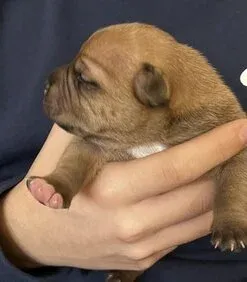
The window that closes
Between roughly 3 and 16 weeks of age, a puppy's brain accepts novelty as normal. What it meets in that period becomes part of its ordinary world; what it meets afterwards has to be evaluated, and evaluation is where fear enters. This is not a gradual fade — the window narrows noticeably from 12 weeks and is effectively shut by sixteen.
The consequence is uncomfortable but useful: the 8 weeks a puppy spends with the breeder are half the entire window, and they are the half you did not control. This is why where a puppy is raised matters more than almost anything else, and why a puppy raised in a kitchen among washing machines, doorbells and visitors starts life meaningfully ahead of one raised in a clean outdoor kennel.
What socialisation actually means
It does not mean meeting as many dogs and people as possible. That is a common and damaging misreading. Socialisation means building the expectation that new things are unremarkable and that nothing bad happens.
The measure of a good exposure is not that it happened but that the puppy stayed relaxed throughout. A puppy dragged into a busy market at 10 weeks and left overwhelmed has not been socialised to markets: it has learned that markets are frightening, and undoing that takes months.
The home checklist
Start indoors, where you control everything. Surfaces first: tiles, wood, carpet, a plastic bag laid flat, a wobbly cushion, wet grass, gravel. Let the puppy choose to walk on each, and reward the choice rather than lifting it across.
Then sounds, and this is the one owners neglect. The vacuum cleaner, the washing machine on spin, the doorbell, a dropped saucepan, the hairdryer, a television with applause. Introduce each at low volume and at a distance, paired with food, and increase gradually across days.
Then handling. Ears touched and looked into, paws held, toes separated, mouth opened, tail held briefly, body brushed all over. 2 minutes a day of this makes veterinary visits and nail clipping straightforward for the next 14 years, and skipping it produces a strong adult dog that has to be restrained for routine care.
Then objects and people: umbrellas opening, suitcases, hats, sunglasses, high-visibility jackets, walking sticks, a bicycle wheeled past. Visitors of different ages, sizes and voices, invited to ignore the puppy on arrival rather than swooping on it.
Learning to be alone
This is the single most neglected item, and the one that causes the most trouble later. A breed that attaches as intensely as this one is predisposed to separation problems, and the prevention costs nothing if it starts in the first week.
Begin with 30 seconds behind a door while the puppy is occupied with something good. Return before it becomes distressed, not after. Extend gradually: a minute, three, ten, thirty. Vary the departure so that picking up keys does not become a signal. Never make a fuss on leaving or returning, which is what turns your absence into an event.
The trap is the opposite of what people expect: a puppy that is never left alone in the first months, because someone is always home, is precisely the puppy that cannot cope at 6 months when circumstances change.
Bite inhibition and the puppy that bites everything
A Staffordshire Bull Terrier puppy uses its mouth constantly, and this is normal, developmental and temporary. It is also the period in which the dog learns how hard is too hard, which is a lesson that must be taught before the adult jaw arrives.
The method is consistent and boring: when teeth touch skin, the game stops immediately and you disengage for 20 seconds. No shouting, no scruffing, no holding the mouth shut. Redirect onto an appropriate toy and resume. Done every time by everyone in the household, this resolves within weeks.
What must not happen is one person allowing rough hand play while another forbids it. Inconsistency here produces an adult that mouths in excitement, and in this breed that is a problem however friendly the intent.
Meeting other dogs, done properly
Quality over quantity, and calm adults over other puppies. A steady, well-mannered adult dog teaches a puppy more about canine communication in 10 minutes than an hour of chaotic puppy play, which often teaches only over-excitement.
Keep encounters short and end them while both dogs are still relaxed. Avoid dog parks entirely at this age: the mixture of unknown temperaments and no supervision is exactly the circumstance in which a formative bad experience happens.
Signs you are going too fast
A puppy that refuses food it normally takes, that yawns repeatedly, that tries to retreat, that tucks its tail or that freezes, is over threshold. Increase distance, lower intensity, and consider the session over.
There is also a normal fear period around 8 to 11 weeks, and often a second between 5 and 6 months, in which a previously confident puppy suddenly finds familiar things alarming. This passes. During it, reduce the pressure and do not force exposures — a frightening experience during a fear period leaves a disproportionately lasting mark.
Frequently asked questions
How many new things a day is right? Two or three, done calmly, beats ten done in a rush. Keep a written list and tick items off over 8 weeks rather than trying to cover everything in a fortnight.
My puppy is frightened of the vacuum cleaner. Start with it switched off in the room, rewarded. Then switched on in another room with the door closed. Then on, at a distance, for 10 seconds. Rushing this creates a dog that panics at appliances for life.
Is puppy class worthwhile? A well-run one, yes, particularly if it includes calm handling and structured exposure rather than 20 minutes of free-for-all play. Ask to observe a session before enrolling.
What if I adopted an under-socialised adult? Progress is slower but real. The approach is the same — distance, patience, food — with the expectation of months rather than weeks, and usually with professional help.