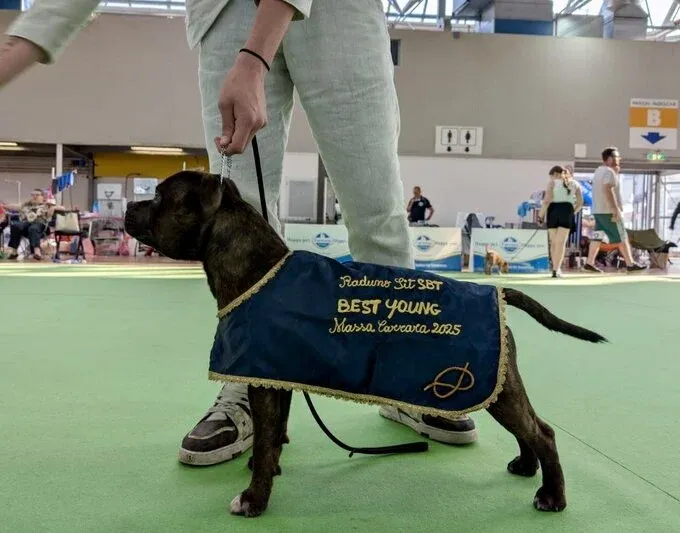
In brief: Getting a Staffordshire Bull Terrier puppy used to staying alone is a gradual process. The goal is to create positive associations, predictable routines and safe environments, preventing separation anxiety and destructive behaviors.
🎯 Key objectives
- Stable routines (sleep, meals, outings, play)
- Progressive exposure to solitude
- Environmental enrichment and chewing
- Prevention of hyper-attachment
Preparing the environment
- Dedicated rest area: bed or pen/x-pen in a quiet area, adequate temperature, water available.
- Safety: remove cables, toxic plants, fragile objects; leave only safe, sturdy toys.
- Background noise: ambient sounds or soft music at low volume can help.
Routine and predictable signals
Make the day readable: alternate activities (play, chewing, walks) with relaxation moments. Include brief rituals before leaving and returning home, keeping tones neutral.
Gradual protocol (7–14 days)
Phase 1 — Micro absences at home (1–3 days)
- Close the gate/pen for 30–60 seconds while staying in sight; return and reward calmness.
- Repeat multiple times, then leave the room for 30–90 seconds. Slowly increase duration.
Phase 2 — Very brief outings (3–7 days)
- Leave home for 1–3 minutes after a calming activity (sniffing/light walk, chewing).
- Return neutrally. If you find agitation, reduce duration in the next session.
Phase 3 — Consolidation (up to 30–60 minutes)
- Extend non-linearly: 5', 8', 4', 12', 6', 15'… Alternating up/down helps avoid expectations.
- Include "chewing breaks" with safe stuffed toys to make absence more pleasant.
🐾 Breeder's advice
With young Staffordshire Bull Terriers, avoid exhausting them completely. Sniffing and chewing activities that center them work better than frantic running before absences.
Chewing and enrichment
- Stuffed toys: with safe recipes and measured portions from their meal.
- Resource rotation: 2–3 different objects on rotation to maintain interest.
- Sniffing games: snuffle mats or kibble scattered in a cardboard box.
Preventing hyper-attachment
- Don't always follow the puppy and don't let them follow you everywhere; use gate/pen positively.
- Sober greetings and returns: no excessive celebrations, reward calmness when they sit or lie down.
- Guided independence: encourage brief "everyone for themselves" moments even when home.
Stress signals to monitor
- Prolonged vocalizations, hypersalivation, destruction aimed at doors/windows, inappropriate elimination.
- If these appear, return to the duration where they were calm and progress more slowly.
- If they persist, consult with vet and qualified trainer.
How long can a puppy stay alone?
Prudent rule: up to 1–2 hours with adequate preparation in the first months, gradually increasing. Arrange family support or pet-sitter for longer days.
📋 Quick checklist
- Safe area ready (pen/x-pen, water, suitable toys)
- Defined daily routine and pre-departure signal
- Gradual protocol planned with non-linear durations
- Stress signal monitoring and fallback if needed